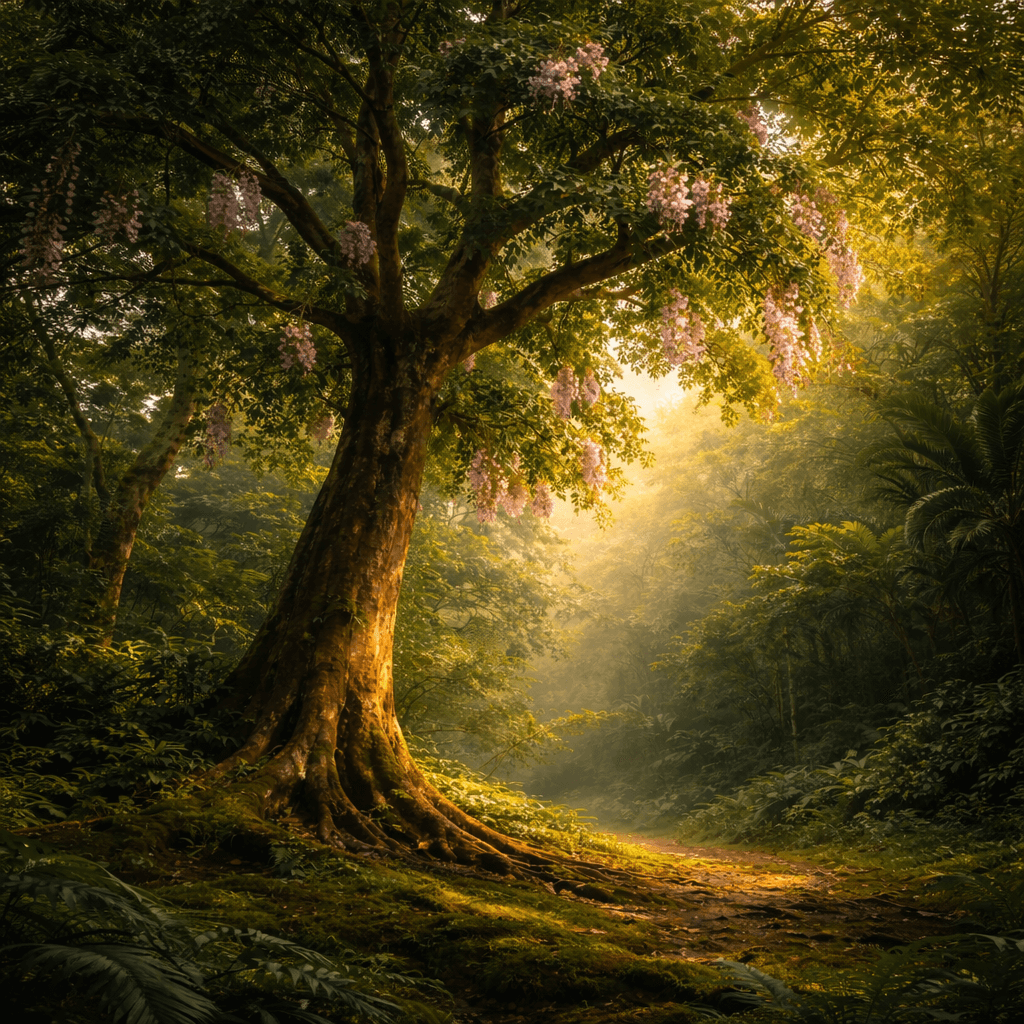
Welcome to the soul realm of the
Feel free to use the table of contents to jump to the part of the portrait that interests you.
By clicking on the main sections, you can go directly to that part of the text and find targeted information if needed.
The portrait is structured in a way that allows you to come closer to the plant – step by step, layer by layer.
Just as you like. ❤️
Wishing you a joyful and heartful encounter with this wonderful plant.

Inhalt
Botanical Identity
Order
Plant family
Subfamily
Tribe
Genus
Species
Growth form
Life cycle
Perennial
A deciduous tropical tree, shedding its leaves during dry seasons, yet regrowing with strength as rains return.
Leaves
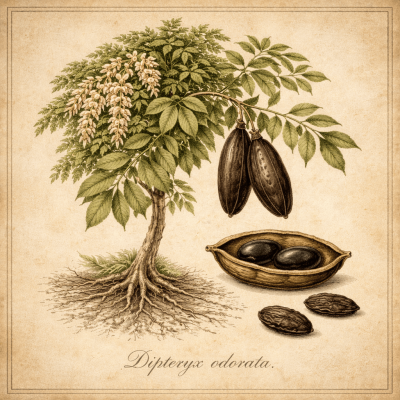
The Tonka bean tree bears large, alternately arranged, imparipinnate leaves that immediately catch the eye in their natural habitus. Each leaf consists of several elliptical to lanceolate leaflets, aligned along a finely winged central axis, forming an elegant, rhythmic structure.
The individual leaflets are leathery and glossy dark green on the upper side, while the underside usually appears slightly lighter and matte. The leaf margins are smooth, and the tips taper finely – conveying both resilience and subtle delicacy.
The entire leaf surface appears smooth and richly structured: the venation is regularly pinnate, adding a vivid pattern to the leaf. In nature, these leaves sway gently in the wind, as if absorbing and reflecting the light of the rainforest.
Summary:
• Shape: Alternate, imparipinnate with elliptical to lanceolate leaflets
• Arrangement: Opposite along the pinnate central axis
• Color: Glossy dark green above, slightly lighter and matte below
• Texture & Special features: Leathery, smooth surface, finely pinnate venation
Flowers
The flowers of the Tonka bean tree appear in loose, multi-flowered panicles that emerge at the ends of the branches, offering a delicate floral garment to the eye in their natural habitus.
Each individual blossom is characteristic of the Fabaceae family (legumes): it exhibits a zygomorphic shape with a clearly defined standard (banner), wings, and keel – a structure that appears both elegant and functional.
The petals display a gentle color palette ranging from white to soft pink and subtle violet hues. These tonal gradients are most vivid when fresh, giving the flowering panicle a subtle liveliness that is especially noticeable in sunlight.
The symmetry of the flower is bilateral, meaning it can only be divided symmetrically along one axis – a typical trait of the legume family. The flowers contain ten stamens, usually fused into two bundles, and a central, superior ovary.
Although each flower appears delicate, together they create a vibrant, almost dancing presence within the panicles, especially when insects visit them for pollination. In nature, the flowers typically open in the late morning and remain visible for several hours before gradually fading.
Summary:
• Shape: Zygomorphic butterfly-like flowers, arranged in loose panicles
• Color: White to soft pink and violet, with gentle gradients when fresh
• Structure: Standard (banner), wings, keel; 10 stamens, superior ovary
• Symmetry: Bilateral (zygomorphic)
• Inflorescence: Loose panicles
Fruits and seeds
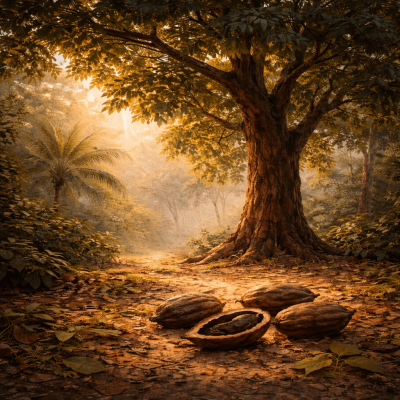
The fruit of the Tonka bean tree is a solitary, round to oval-shaped drupe that, when ripe, develops a hard, woody shell. It forms after flowering in the upper branches and matures over the course of the year into a firm, resilient structure. Once fully ripe, the fruit typically reaches several centimeters in length and displays a brown to dark brown color, with a dry, relatively smooth outer surface.
Fruit maturation occurs during the late rainy season through the beginning of the dry season, depending on the local climate. When fully ripe, the fruit usually falls intact to the ground; it does not open actively through any splitting mechanism. In nature, fallen fruits are gradually broken open by animals—particularly rodents or small mammals—revealing the seed inside.
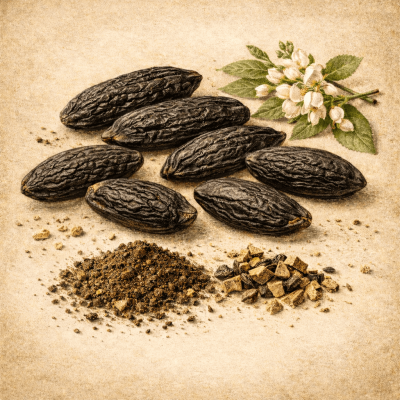
Inside the stone-like fruit is typically a single seed, known as the Tonka bean itself. This seed is elongated, slightly flattened, and features a wrinkled, almond-like surface with a dark, black-brown sheen. Its shape is usually ellipsoid to slightly curved, and the surface appears dry, firm, and resistant to mechanical stress.
The Tonka bean emits a characteristic fragrance—a strong, vanilla-like aroma that can already be detected within the fruit and becomes even more pronounced once the outer shell is removed. These scent notes are caused by aromatic compounds contained in the seed, which are more intense when fresh.
The seeds are relatively large and heavy, making wind dispersal unlikely. Instead, their natural distribution depends on animals and gravity: fallen fruits remain on the forest floor, where soil organisms, rain, and animal activity contribute to their decomposition and the eventual release of the seed. Due to their dense, durable nature, the seeds are highly storable and can be preserved under suitable dry conditions for extended periods without spoiling quickly.
Summary:
• Fruit type: Solitary drupe with a woody shell
• Ripening period: Late rainy season to early dry season (climate-dependent)
• Fruit color/shape: Brown to dark brown, round to oval
• Seed: Elongated, ellipsoid, dark brown, wrinkled surface, vanilla-like scent
• Dispersal: Via animals and gravity; not wind-dispersed
• Storability: High (woody shell, dry storage possible)
Bark and inner structures
The bark of the Tonka bean tree appears grayish-brown to slightly brown-black on the outside. In older specimens, it develops characteristic fissures along the trunk, with parts of the surface cracking irregularly and forming areas of flaking, scale-like texture. When freshly injured, the bark releases a warm, mildly sweet and woody scent that faintly echoes the aromatic compounds found in the seed—though this fragrance remains subtle and hidden, quite unlike the intense aroma of the bean itself.
The wood is medium-hard to hard, notably dense, and features a fine, evenly running grain. Its coloration ranges from yellowish to reddish to dark brown, depending on age and cut. In some trunks, a faint vanilla-like scent may be detectable in the deeper layers, usually only when freshly cut.
The roots of the Tonka tree are strongly developed and penetrate deeply into the ground. It has a typical taproot system with fine, branched lateral roots. The outer surface of the root bark is dark to black-brown, while the inner tissue is lighter, fibrous, and rather dry. The plant does not form rhizomes or tuberous storage organs.
No latex or sticky resin is exuded when the plant is injured—this tree does not belong to the resin-producing species. Even when more severely damaged, the cross-section remains relatively dry.
Inside the trunk, a narrow, inconspicuous pith is visible, without any pronounced hollow spaces or tubular systems. Its internal structure is stable but unremarkable, shaped by functional adaptation to the hot and humid climate of its tropical habitat.
Summary:
• Bark: Gray-brown, fissured, with scale-like flaking; faintly fragrant when injured
• Wood: Yellowish to reddish-brown, medium-hard, finely grained, mildly aromatic
• Roots: Deep-reaching, branched; dark on the outside, fibrous and dry inside; no rhizomes
• Latex/Resin: No sap or resin when damaged
• Internal Structures: Narrow pith; no special storage organs or tube systems
Sensory qualities
The Tree
When encountered in its natural habitat, the Tonka bean tree feels at first silent and powerful – as if it observes more than it shows. It grows tall, sometimes reaching over 25 meters, with a broad, composed crown. Its trunk is straight, strong, and marked by deeply gray, fissured bark. In its surroundings, it often stands out – not by noise or showiness, but through a kind of alert presence.
The crown appears closed, almost like a protective canopy, casting a calm, filtered light on the ground below. When wind moves through its branches, the tree barely sways – only the finer twigs tremble slightly, as if it were sensing the weather, but not reacting to it.
During the dry season, the air beneath the tree carries a faintly sweet scent, especially when the ripe fruits have fallen. Sometimes a trace of vanilla lingers above the earth, elusive yet comforting. The tree seems old even when young – not because of its rings, but because of something in its bearing.
Those who linger near it often feel a quiet sense of order radiating from it – not rigid, but rhythmic. It is not a tree that calls. It is a tree that waits.
The Dried Bean
The dried Tonka bean unfolds an intense, warm fragrance that reaches deep into the field of memory. It is sweet and balsamic, with clear vanilla notes and a hint of marzipan, hay, and faint smoky undertones. At times, the scent carries a leathery depth – soft and dark at once – as if the wood of the tree lived within it. It lingers in the air for a long time without being intrusive, seeming to cling more to skin or fabric than to dissipate.
The Beans
The bean’s surface is hard, slightly curved, and wrinkled. In the hand, it first feels cool and dry, but with time a slight, almost oily sheen may appear. Between the fingers, it feels firm and compact – not brittle, but resilient and smooth in the creases, where fine gray crystals may settle.
The color of the dried seed is a deep, almost black brown, with areas of violet shimmer – especially where light hits it at an angle. The grooves are lighter and sometimes covered with a grayish film.
For those bold enough to place a trace of the powdered seed on the tongue, a sweet-aromatic flavor reveals itself – reminiscent of vanilla, light wood, and a distant touch of bitterness. Not sharp, not piercing – but enveloping, soft, and surprisingly long-lasting. It feels more round than pointed, more deep than fleeting – a taste that evokes old books, warm rooms, and the gentle afterward of a long day.
Summary:
• Scent: Sweet, balsamic, vanillic, hay-like, with marzipan-like depth
• Touch: Hard, wrinkled, lightly oily when warm, cool and compact
• Color: Deep brown to black with violet sheen and gray crystal film
• Taste: Sweet-aromatic, soft, with subtle bitter tones – long-lasting
Traditionally used plant parts
Traditionally, the seed — known as the Tonka bean — was the primary plant part used, especially in its dried and often ground form. Its dark, wrinkled surface and its intense, sweet‑warm fragrance made it a symbolic carrier of heartfelt wishes and good fortune in many cultures.
In parts of South America, particularly in Venezuela and Brazil, the Tonka bean was used in rituals intended to fulfill wishes. People placed it under their pillow, wore it as a scented amulet close to the heart, or burned it as a fine powder on charcoal to release their petitions into life. The ascending scent was regarded as a messenger between worlds — a quiet invitation to fate.
In European contexts as well — especially during the 19th century — the bean found its place as a fragrance carrier in scent sachets, prayer pouches, or ritual blends. It was believed to promote tenderness, courage for intimacy, and a soft heart — which is why in some regions it was given as a token of love or a symbol of reconciliation.
In addition to the seed itself, the Tonka‑bearing wood of the tree was occasionally used in ritual contexts — for example, carved as a lucky charm or used to scent small spaces — though this was relatively rare compared to use of the bean.
The leaves, flowers, or bark were traditionally seldom used — remaining largely in the shadow of the powerful, fragrant seed.
Summary:
• Used plant part: Primarily the seed (Tonka bean), dried or ground
• Levels of use:
– Sensory: Fragrance, flavor (folk cuisine, aromas)
– Spiritual: Incense plant, wish rituals, amulet
– Symbolic: Fortune, love, heart‑opening
• Not traditionally used: Leaves, bark, flowers — little to no documented use
Ecology & Habitat
Origin and distribution
The Tonka bean tree (Dipteryx odorata) is a species of flowering tree in the legume family (Fabaceae) native to the wet tropical regions of northern South America. Its natural range extends across the Amazon Basin, from Venezuela through Guyana, Suriname, French Guiana, and northern Brazil (including Pará and Amazonas) into parts of Colombia and eastern Peru. 
In these regions, the tree grows naturally in moist lowland rainforests and forest edge habitats, where high humidity, stable warmth, and fertile, well‑drained soil support its growth. It is typically found in light‑filled gaps of the forest, along riverine edges, and in undisturbed tropical forest terrain. 
Although some wild populations persist, most of the Tonka beans traded today derive from cultivated or sustainably harvested stands, particularly in Venezuela, Brazil, and Colombia, where agroforestry systems integrate Dipteryx odorata with other species. 
Historical trading networks beginning in the 18th century spread awareness of the tree beyond its native range. Experimental cultivation occurred in parts of Africa and Asia (e.g., Nigeria, Sri Lanka, Indonesia), but these plantings never became ecologically established or commercially significant outside the species’ native tropical range. 
Because Dipteryx odorata depends on consistent humidity, warm temperatures, and specific ecological relationships found in tropical rainforest systems, it has not naturalized in temperate regions such as Europe. Its distribution remains closely tied to the Amazonian and adjacent tropical forests where it evolved. 
Summary:
• Origin: Tropical northern South America (notably Venezuela, Brazil, Guyana, Suriname, French Guiana, and adjacent areas)
• Natural presence: In rainforest edges and moist lowland forests
• Cultivation: Mainly in native South American regions, often integrated into agroforestry
• Modern distribution: Predominantly within South America; not established in temperate zones
• Particularity: Reliance on tropical climate and ecological relationships prevents naturalization elsewhere
Habitat and site conditions
The Tonka Tree (Dipteryx odorata) thrives in the humid lowland rainforests of South America, particularly in the shaded understory layers of the Amazon region. It prefers humus-rich soils that are slightly acidic to neutral, well-drained yet consistently moist without becoming waterlogged. A typical feature is a certain clay or sandy-loam texture, which offers a stable yet aerated rooting environment.
The tree feels most at home in partial shade beneath the canopy of towering forest giants – protected by a natural leaf roof that softens direct sun exposure while preserving the warm, humid microclimate. It tolerates full sun only when soil moisture remains reliably high.
Natural habitats are usually found at low elevations below 400 meters, often near riverbanks or in seasonally flooded forest areas, where the microclimate is especially stable and humidity is high. Climatic conditions are marked by steady temperatures, high atmospheric moisture, and distinct rainy seasons followed by dry periods – a rhythm to which the tree is well adapted.
When it comes to environmental changes, the Tonka tree is relatively sensitive: major disturbances to the soil ecosystem or sudden changes in light can negatively impact its growth. In monocultures or drier regions, it tends to grow more slowly or may even stagnate.
Summary:
• Soil: Humus-rich, permeable, slightly acidic to neutral, consistently moist
• Light: Partial shade under forest canopies
• Altitude: Tropical lowlands (up to ~400 m)
• Climate: Warm and humid, with high humidity and distinct wet/dry seasons
• Sensitivity: Site-faithful and climate-dependent, reacts to disruptions
Ecological relationships
In the humid shadow forests of the Amazon, the Tonka bean tree lives in quiet exchange with its surroundings.
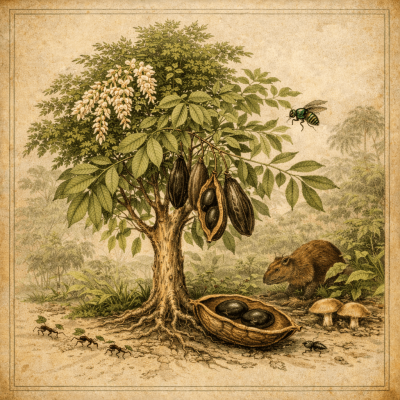
Its delicately scented blossoms open during the dry season, releasing a fine, vanilla-like fragrance that attracts bees and small beetles. These pollinators linger between the flower cups, gently transferring pollen as they move.
When fruiting begins – often after the first rains – the heavy, dark brown drupes fall to the forest floor and become food for animals. Rodents such as agoutis are especially fond of them: they crack the hard shells, carry seeds away or bury them as a food reserve – unknowingly assisting in the tree’s propagation.
The tree itself supports the forest by anchoring its often clay-rich soils with broad-reaching roots and by shading the moist microclimate beneath its expansive crown. Sometimes, bright green parrots nest in its branches, and insects find shelter beneath its bark, especially those that colonize deadwood.
Thus, the Tonka bean tree does not stand in isolation, but is deeply embedded in a finely tuned web of relationships – as a bearer of scent, a provider of habitat and nourishment, and as a silent storyteller at the heart of the tropics.
Conservation status and threats
The Tonka bean originally comes from the tropical rainforests of South America, especially the northern Amazon region (for example, Venezuela, Brazil, Guyana), where it grows as a large, majestic tree (Dipteryx odorata) in warm, humid, species‑rich forest systems. 
In some regions, wild populations are considered to be in decline, largely due to deforestation, infrastructure development, and the loss of intact forest ecosystems. Although Dipteryx odorata is currently not globally listed as threatened by extinction, its conservation remains relevant in the context of rainforest protection. 
In several countries, the wild collection of the beans is legally regulated. In Brazil, for example, care is taken to ensure that only mature, naturally fallen fruits are gathered – a gentle way of harvesting that minimizes harm to trees, soil and wildlife. 
The Tonka bean tree is included in Appendix II of the CITES Agreement (the Convention on International Trade in Endangered Species of Wild Fauna and Flora). This means that international trade is permitted but regulated to help prevent over‑exploitation of the species. Under Appendix II, trade is allowed only if it is sustainable and does not negatively affect the species’ survival in the wild. 
In recent years, sustainable cultivation projects have also emerged, growing the beans in ways that do not burden wild populations. A conscious and respectful approach to this noble plant — whether as a fragrance bearer, a ritual plant, or a symbol — contributes to preserving its native home and ecological baseline.
Constituents & Sphere of Action
Constituents
The Tonka Bean contains a wide range of aromatic compounds that give it its characteristic scent and flavor. The primary contributor to its intense aroma is coumarin – a naturally occurring secondary plant compound that is stored in high concentrations within the dried seeds. Additionally, further aromatic derivatives have been identified, including dihydrocoumarin, methylene-bridged compounds, and traces of essential oils.
Besides these main substances, the bean also contains fats, proteins, polysaccharides, harpagide-like bitter compounds, tannins, and mineral components. The exact composition may vary depending on origin, growing region, and drying method.
In the field of aromatic plant studies, Tonka bean is often described as a fragrant raw material that produces a warm, sensually soft note. Its constituents are traditionally not extracted as essential oil, but rather used in the form of absolutes or CO₂ extracts – primarily in perfumery and ritual contexts.
From the perspective of folk medicine, the plant was considered in parts of South America to be soul-related, luck-bringing, and atmospherically active – again, with the aromatic profile being seen as the carrier of these qualities, not as a medical substance in the narrow sense.
⸻
Summary of confirmed key constituents (without any health claims):
• Coumarin (high concentration, natural aromatic compound)
• Dihydrocoumarin
• Essential components (traces, not extracted as EO)
• Fats & proteins
• Polysaccharides
• Tannins
• Accompanying compounds from the plant matrix
Essential oils
Includes, among others:
• Coumarin
• Dihydrocoumarin
• Coumarin derivatives (e.g. 3,4-Dihydrocoumarin)
• Vanillin (in trace amounts)
• Benzyl alcohol
• Cinnamic acid esters (e.g. benzyl cinnamate)
• Salicylates (e.g. benzyl salicylate, methyl salicylate)
• Styrene
• Safrole (in traces)
• Benzoic acid esters (e.g. benzyl benzoate)
💡 Note on classification:
The Tonka bean is not considered a classic essential oil plant in the sense of steam distillation. Its constituents occur in concentrated lipophilic form or as an absolute/extract rather than as a traditional essential oil. The listed components are primarily aromatic molecules, similar to those found in perfume raw materials and aromatic resins.
Fragrance profile
The scent of the Tonka bean unfolds as warm, sensual, and multi-layered. From the very first pause, a sweet, balsamic note rises—evoking hints of vanilla, marzipan, and delicate hay. Deeper tones recall dried wood and a touch of cinnamon, where a spicy warmth blends with the subtle bitterness of dried herbs. The fragrance lingers for a long time, acting like a fragrant bridge between comfort and vast dream worlds—distinctively tonka and unmistakable.
Aromatic effects
The scent of the tonka bean unfolds a warm, sensual presence that many people perceive as comforting.
In various traditions, it has been associated with the opening of the heart and regarded as a carrier of sweet memories, gentle emotions, and quiet security.
In traditional fragrance lore, its aroma is linked to grounding, soothing, and consoling qualities.
There is a subtle depth within it that can fill a space without dominating—like a gentle veil that envelops, warms, and touches the senses.
Some describe it as an invitation to inner stillness, a scent that resonates with remembrance and belonging.
In certain cultures, it was used as a ritual fragrance to anchor the inner self—soft, holding, soul-warming.
Harvest & Handling
🌿 Note on Respectful Engagement with the Plant:
In a world where many plants are available in organic quality from trustworthy, ecological sources, it is often the more mindful choice not to harvest them yourself in the wild.
However, if you do choose — with preparation and awareness — to encounter a plant in its natural habitat, let it be out of relationship, not out of need. Pay attention to the diversity and vitality of the site, tune in to yourself and sense whether your gathering is truly aligned — and always remember: Never take more than you truly need — and always leave more than you have taken.
Harvesting periods
Harvesting months
Harvesting notes
The tonka bean is traditionally harvested after the ripe fruits have naturally fallen from the tree. Once collected, the beans are separated from the fruit pulp, washed, and slowly dried. To develop their characteristic aroma, a fermentation process follows—often involving alternating phases of air-drying and storage.
Usage
🌿 Note on usage
The applications mentioned here are based on traditional knowledge, personal experience, and freely available information about plants. They are meant to inspire – not to instruct self-treatment or consumption.
Please keep in mind:
• Follow the legal regulations and official guidelines of your country – not all plant substances are approved for internal use everywhere.
• Always check for potential ingredients, intolerances, or interactions before working with a plant in practice.
• In case of health issues or concerns, consult a qualified professional you trust.
This information is not a substitute for medical, therapeutic, or legal advice. Rather, it aims to open a space for mindfulness, remembrance, and connection to the plant world.
The tonka bean is a fragrant ambassador of sensuality. Its aroma – warm and deep – evokes vanilla, hay, and delicate almond notes, leaving an impression not only in the kitchen but also on the soul. Traditionally, it is used in tiny amounts as a spice to refine desserts, pastries, or liqueurs with a unique touch. As fine as its scent may be, it should be used with care: the bean contains the natural plant compound coumarin, which can be harmful in larger quantities. Therefore, the rule is: less is more. In Germany, its use in food is regulated – the bean may not be sold freely as a spice, but can be purchased in small amounts as a flavor carrier. Its use is the responsibility of each individual.
But the tonka bean is much more than a kitchen spice. For centuries, it has been revered as a ritual plant in various cultures. In South America, for example, it is used in blessing, love, and success rituals, where it is believed to increase goodwill and warm energy. Its profound, almost mystical presence makes it a popular element in incense rituals, where its balsamic fragrance opens spaces and touches hearts.
It is also often carried as a talisman or amulet – whether as a symbol of luck, protection, or inner alignment. In fragrant herb sachets or pillows, it can unfold its effects quietly and steadily – a gentle companion for dreams, spaces, and rituals.
Thus, the tonka bean unites the sensual with the symbolic, the physical with the subtle. In its small, wrinkled form, it holds a world of fragrance, depth, and cultural meaning – a plant that calls for respect and mindful use.

Cultural Roots & Energetic Dimensions
🕊️ Note
Thefollowing reflects subtle, symbolic, and culturally transmitted aspects of the plant.
It is based on traditional worldviews, intuitive experiential knowledge, and spiritual associations from various cultural backgrounds.
These contents do not replace botanical knowledge or medical advice – rather, they honor the many ways in which plants are deeply connected to our human experience.
following information reflects subtle, symbolic, and culturally transmitted aspects of the plant.
It is based on traditional worldviews, intuitive experiential knowledge, and spiritual associations from various cultural backgrounds.
These contents do not replace botanical knowledge or medical advice – rather, they honor the many ways in which plants are deeply connected to our human experience.
Energetic essence of the plant
The tonka bean is a plant of remembrance.
Its warm fragrance carries the echo of ancient songs within it – songs that were never sung aloud, yet resonate inside us when we become still.
It does not remind us of events, but of states of being: the feeling of having been loved – or of daring to hope for it again.
As an ancestral plant, it carries the resonance of past lineages within it.
Not only of familial origin, but of soulful depth.
In the forests of South America, it was smoked, offered, and honored – as a gift to the unseen, as a gesture toward that which connects us.
Within its scent lives a quiet language. Sometimes, simply breathing it is enough to feel less alone.
Tonka is also a bridge plant.
It connects dreaming and waking, yesterday and now, inner and outer worlds – without tearing, without pulling.
It gently threads lines of connection, weaving memory into touch, scent into feeling, the past into comfort.
It demands no form – it works through presence.
In ritual contexts, it often meets us as a dream plant, and sometimes as a threshold plant.
It opens doors, but does not step through them. It invites, but does not linger.
In this way, it protects transitions – between day and night, between loss and new beginnings, between what is ready to leave and what has not yet revealed itself.
Some call it a plant of light, because its essence radiates comfort without blinding.
It touches what wishes to soften – within us, around us, with us.
And sometimes – very rarely – it also appears as a guardian: when gentleness needs to be protected from the grasp of the world.
At its center, however, rests a core:
Love.
Not the loud, demanding kind – but the kind that remembers through scent, heals through gesture, and remains through silence.
The tonka bean gives nothing that you are not ready to receive.
But if you are ready, it will remind you of who you were before you forgot how tender you are.
Soul levels
The tonka bean feels like a silent embrace in the midst of the storm.
She touches the space of gentleness – not as weakness, but as a quiet strength that protects and heals.
Her warm, sweet scent weaves itself deeply into the heart field and opens that inner place where trust may grow again – even after times of abuse or overwhelm.
She is a being of centering – helping to return to one’s own middle when everything seems to dissolve.
And within that center lies the courage to let go of what no longer holds.
The tonka bean whispers of release – not in the sense of loss, but as an invitation to gently exhale old pain and realign from within.
When the soul is cold, she offers comfort – not loudly, not insistently, but like a gentle hand resting on the shoulder.
Within her subtle presence lies the impulse of heart-opening:
a quiet remembering of the deep joy that comes from remaining touchable – despite everything.
And sometimes, ever so softly, she lifts the theme of forgiveness.
Not as an obligation, but as a possibility.
As a call of the heart – to release oneself and others from ancient chains.
In her wholeness, she is like a balm for wounded souls –
a being who brings strength not through struggle,
but through resonance with what is true.
Planetary influence
In traditional doctrine of signatures, the tonka bean is often associated with Venus – as a symbol of gentleness, connection, and the quiet beauty of the heart.
Its scent, often reminiscent of vanilla, carries a soft, enveloping force that resonates with the archetypal qualities of Venus – love, comfort, and harmonising influence.
At the same time, in its deep, almost meditative presence, one can also sense Saturnian qualities: a connection to the past, to memory, to silent ripening in inner depths.
Thus, it rests – as if between the worlds – in the tension between Venus and Saturn: gently connecting, yet preserving with structure.
Elemental power
The tonka bean unites two symbolic forces that may seem opposed at first glance – yet within her, they merge into a quiet harmony:
The element of Air reveals itself through her scent – weightless, floating, like a song only the heart can hear.
She stirs memory, sets inner images into motion, and drifts through space like a breath: intangible, yet touching.
In the language of the elements, Air stands for lightness, clarity, and communication on a subtle level – all qualities that dwell in Tonka’s way of working.
At the same time, she is rooted in the element of Earth:
The tonka bean grows hidden inside a hard shell, from a deeply rooted tree – steadfast, grounded, holding inner wealth.
She reminds us of what carries us – of origin, of ancestral lines, of trust in something silent and deep.
The Earth element offers stillness, continuity, and a sense of being held – exactly what Tonka is able to offer in times of transition.
In her unique nature, she brings together memory and presence, scent and root, floating and grounding.
She is a plant of connection – between sky and soil, between thought and feeling.
Mythical world
“In the mythic world of many Indigenous cultures, the tonka bean is revered as a bearer of wishes, transitions, and luminous forces.
Its sweet, resinous scent is seen as an invitation to the unseen – to spirits, ancestors, and the memory of what once was.
In some regions of the Amazon, it is said that the bean attracts lightning to cleanse the field – a plant that draws celestial fire into the earth, driving away parasites in the process.
Thus, it became a guardian of thresholds: between light and shadow, life and death, dream and awakening.
A bearer of rites of passage, protection rituals, and the gentle hope that the soul might remember the light.”
Healing systems
The tonka bean is known in several healing traditions of South and Central America – particularly within Amazonian shamanism, Mayan medicine, and Andean plant knowledge.
In these traditional systems of wisdom, it is not regarded merely as a substance, but as a being – a forest creature whose fragrant powers mark transitions, open ancestral realms, and support inner clarity.
Its sweet, warm scent has been interpreted as a bridge: between shadow and light, illness and hope, earth and spirit.
Shamanic paths
The Tonka Bean (Dipteryx odorata) is known in several shamanic lineages of Latin America – as a plant of spiritual depth, fragrant presence, and connection to transitions.
In Amazonian shamanism – especially in the Amazon basin of Brazil, Colombia, and Peru – it is regarded as a plant associated with energetic cleansing and protective space. Its characteristic scent is linked to the presence of benevolent forces and the clearing of the energetic field.
In the Mazatec plant paths of Oaxaca (Mexico), where language, song, and fragrance are central, the sweet, enveloping quality of the tonka bean creates a symbolic resonance. Plants here are seen as guiding teacher-beings, conveying messages through dreams and silence.
The Kichwa and Quechua traditions of the Andean region often regard bean species as seed forces, connected to cosmic origin and cyclical renewal. In their cosmologies, every plant is embedded within a living order of ancestors, elements, and seasons.
In Curanderismo – the traditional healing path of Mexico and Central America – fragrance is used as a carrier of intention and prayer. The tonka bean naturally integrates into practices that work with buen aire (good air) and alignment toward harmony and balance.
Within Wixárika (Huichol) shamanism of northern Mexico, plants that stimulate trance, memory, and expanded perception are part of a spiritual weave oriented toward vision and cosmic order. While the tonka bean is not one of the core ritual plants in this tradition, its aromatic symbolism offers associative bridges to trance work and beings of light.

© 2025 ThePlantSoul by Mia